Aerial yoga is a modern approach to yoga that combines traditional yoga postures with the support of a suspended fabric hammock. Unlike conventional yoga, where the body remains primarily connected to the floor, aerial yoga allows practitioners to move, stretch, balance, and relax while partially or fully supported by a soft fabric sling. This unique practice has become increasingly popular among people who want to explore yoga in a creative and enjoyable way.
For beginners, aerial yoga can look challenging at first. Seeing practitioners hanging upside down or moving through suspended poses may create the impression that the practice requires advanced flexibility or athletic ability. In reality, aerial yoga can be adapted to different fitness levels when it is taught by a qualified instructor and practiced with appropriate equipment. People who are interested in developing a broader understanding of yoga may also explore yoga teacher training in rishikesh, where structured learning can introduce students to different aspects of yoga practice, philosophy, and teaching.
What Is Aerial Yoga?
Aerial yoga is a yoga-based practice performed with the assistance of a fabric hammock suspended from a secure support system. The hammock acts as a prop that can support parts of the body, assist with stretching, or provide additional resistance during certain movements.
Depending on the style and class, aerial yoga may include elements of traditional yoga, Pilates, stretching, strength exercises, breathing practices, and relaxation. Some classes keep the hammock relatively close to the ground, while others involve more elevated movements.
How Does Aerial Yoga Work?
A typical aerial yoga class begins with a warm-up to prepare the muscles and joints. Beginners may practice simple standing movements, supported stretches, and basic balance exercises before progressing to more complex positions.
The instructor usually demonstrates how to sit, stand, lean, and move safely with the hammock. Participants gradually learn how to distribute their weight and maintain control while using the fabric.
Some movements keep the feet on the floor, while others allow the practitioner to lift one or both feet. Advanced classes may include inversions, where the body is positioned upside down with appropriate support.
The hammock can be used in several ways:
As a support during stretching
As a prop for balance
As assistance during inversions
As resistance during strength movements
As a tool for deeper relaxation
As a way to explore movement in different directions
Because the hammock responds to body movement, practitioners must develop coordination and body awareness as they become more comfortable.
Benefits of Aerial Yoga
Aerial yoga offers several potential physical and mental benefits. Individual experiences can vary depending on factors such as consistency, fitness level, instruction, and overall health.
1. May Improve Flexibility
The hammock can provide gentle support during stretching exercises. This support may allow practitioners to explore a comfortable range of motion without placing excessive pressure on certain areas of the body.
For example, a supported hip or hamstring stretch can feel different from the same movement performed on a yoga mat. Over time, regular practice may help improve mobility and flexibility.
It is important, however, not to force a stretch simply because the hammock makes a deeper position possible. Comfortable progression is more valuable than trying to achieve a dramatic pose quickly.
2. Supports Balance and Coordination
Aerial yoga introduces an unstable element because the hammock can move beneath the body. Practitioners must learn to control their movements and adjust their posture accordingly.
This can encourage better coordination and body awareness. Simple exercises such as standing with partial hammock support may require concentration because even small shifts in weight can affect stability.
With regular practice, students may become more familiar with how their body responds to changes in position.
3. Can Build Functional Strength
Although aerial yoga may appear gentle, many movements require muscular engagement. The core, legs, arms, shoulders, and back may all become involved depending on the exercise.
Holding the body in a supported position requires control rather than simply relying on the hammock. Certain sequences can therefore contribute to muscular endurance and overall body strength.
Beginners should focus on controlled movements rather than attempting difficult poses before developing the necessary strength.
4. May Reduce Some Pressure During Movement
One of the distinctive features of aerial yoga is that the hammock can support part of the body’s weight. This may make certain movements feel less demanding on the floor.
For some practitioners, this supported environment can provide a comfortable way to experiment with movement. However, aerial yoga is not automatically suitable for everyone with joint or physical concerns. Anyone with an injury or medical condition should seek appropriate professional advice before participating.
Common Aerial Yoga Techniques
Beginners generally start with basic techniques before moving toward advanced aerial sequences.
Supported Forward Fold
In a supported forward fold, the hammock can assist the body while the practitioner gently folds forward. The exercise may help create a feeling of support while stretching the back and legs.
The movement should remain comfortable, with no need to force the body toward the floor.
Aerial Lunges
The hammock can be used to support one leg during a lunge variation. This may allow practitioners to experiment with balance while strengthening the legs and improving hip mobility.
Beginners should learn how to enter and exit the position safely before holding it for longer periods.
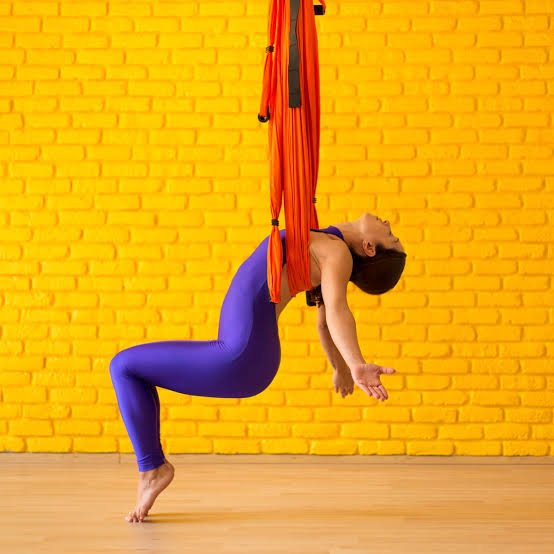
Supported Backbend
Some aerial yoga classes introduce gentle backbend variations using the hammock for support. These movements should be performed gradually because the spine and shoulders require appropriate preparation.
The goal should be comfortable movement rather than achieving a deep backbend.
Aerial Plank
The hammock can be positioned to support the legs or hips during plank variations. This can introduce additional instability and require greater engagement from the abdominal and upper-body muscles.
Beginners should first develop a strong understanding of a regular plank before attempting more challenging aerial variations.
Basic Inversions
Inversions are among the most recognizable aerial yoga movements. A practitioner may use the hammock to support the hips or legs while the body moves into an upside-down position.
Beginners should never attempt inversions without proper instruction. Learning how to enter, hold, and exit an inversion safely is essential.
Is Aerial Yoga Suitable for Beginners?
Yes, aerial yoga can be practiced by beginners when the class is specifically designed for newcomers and proper instruction is provided.
You do not need to be extremely flexible to begin. You also do not need to know how to perform advanced yoga poses. A beginner class should introduce the hammock, basic body positions, simple stretches, and safe transitions before progressing.
The most important qualities are patience, attentiveness, and willingness to learn.
Beginners should avoid comparing themselves with experienced aerial practitioners. Someone who has practiced for years may perform movements that initially seem impossible. Progress in aerial yoga comes from consistent practice and learning proper technique.
How to Prepare for Your First Aerial Yoga Class
Before attending your first class, avoid eating a large meal immediately beforehand. A light meal several hours before practice may be more comfortable for many people.
Arrive early so you have enough time to become familiar with the equipment. Tell the instructor that you are new to aerial yoga and mention any relevant physical limitations or previous injuries.
During the class, focus on understanding the fundamentals instead of trying to perform every movement perfectly.
It is completely normal to feel uncertain when using the hammock for the first time. With practice, movements that initially feel unfamiliar usually become easier to understand.